Which products, if purchased first, bring in the highest LTV customers?
For most Shopify merchants, the first sale is often the hardest, and the most expensive to get. But is your first item sold - also the last? The successful scaling in ecommerce isn't about getting that first customer: it’s knowing which products turn buyers into brand loyalists.
If you’ve ever wondered, "Which product should I actually be running ads for?" the answer isn't necessarily your bestseller. It’s your best gateway product. Which items, when sold in the first order, result in the highest lifetime value customers?
In this article we’ll explore a custom Google Analytics 4 framework for tracking sequential purchase behavior.
The GA4’s missing link
Standard Google Analytics 4 (GA4) is great at telling you what people bought, but it doesn’t help much with understanding which products belong to which order number. To solve this, Littledata uses a proprietary user-scoped GA4 parameter called purchase_count, which increments every time a customer buys.
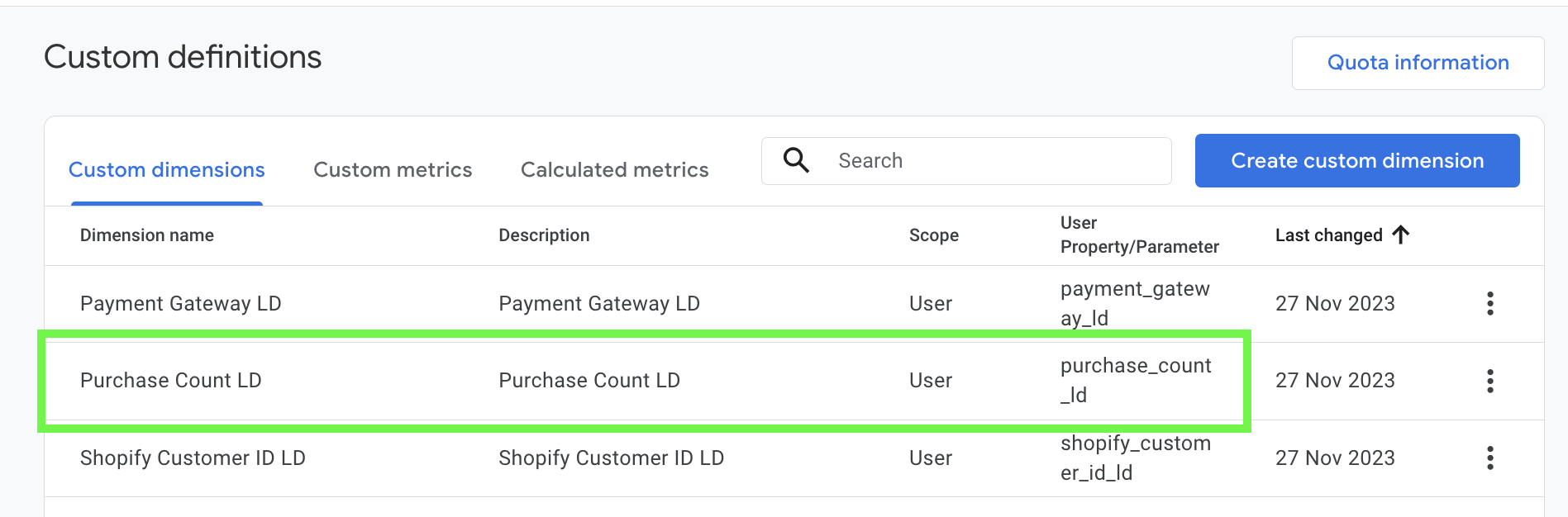
Even though Google Analytics 4 reuire you to register custom parameters manually, Littledata does it automatically for you behind the scenes!
Using this powerful information, we’ve built two reports to identify the "North star" of your product catalog, all the while exposing your ‘one-hit-wonder’ products that burn your ad budget and bring underperforming customers in the long run.
Report 1: the sequential growth map
This report starts with a simple hypothesis: What do customers, who buy item X in their first purchase, buy in their subsequent orders?
Let’s create a GA4 segment of users who purchased a specific product in Order #1:
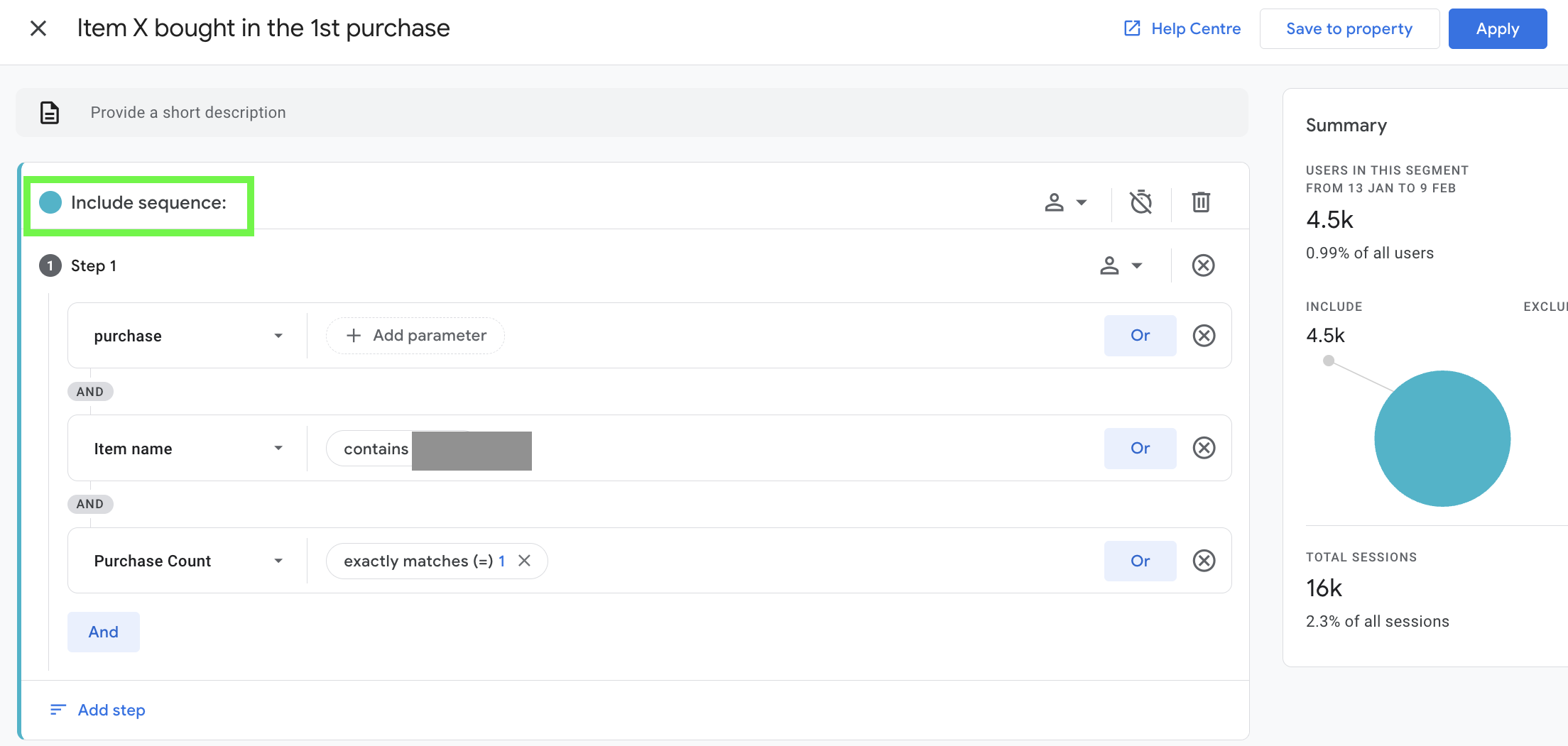
This way we’ll be able to quantify products this group of people bought in their orders #2, #3, and #4 etc.
It’s important to note that the segment is built as a sequence so it has an open ended structure - users who kept buying after they bought this product particularly in their first purchase.
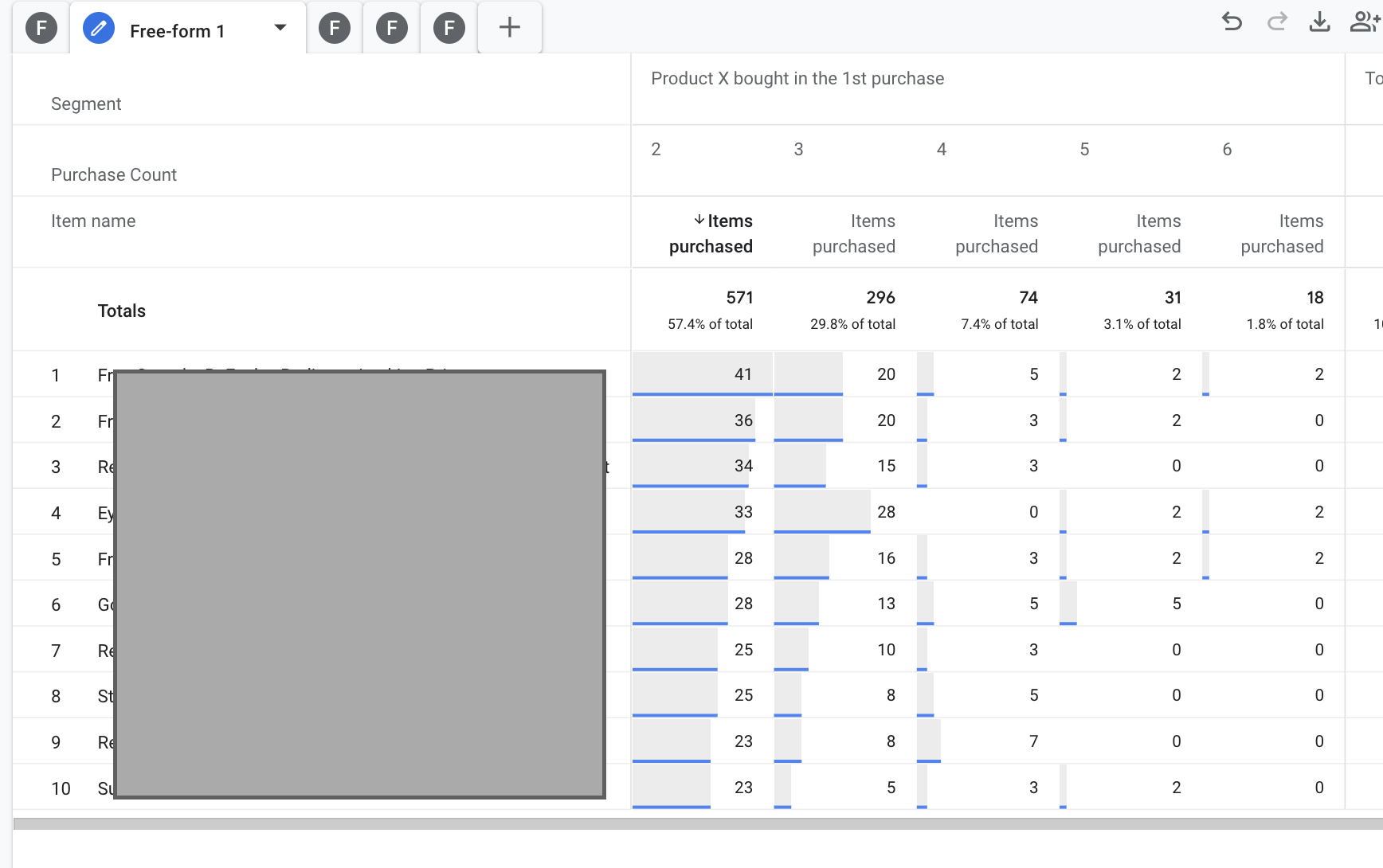
Now let’s look at the same report only with item_revenue as metric:
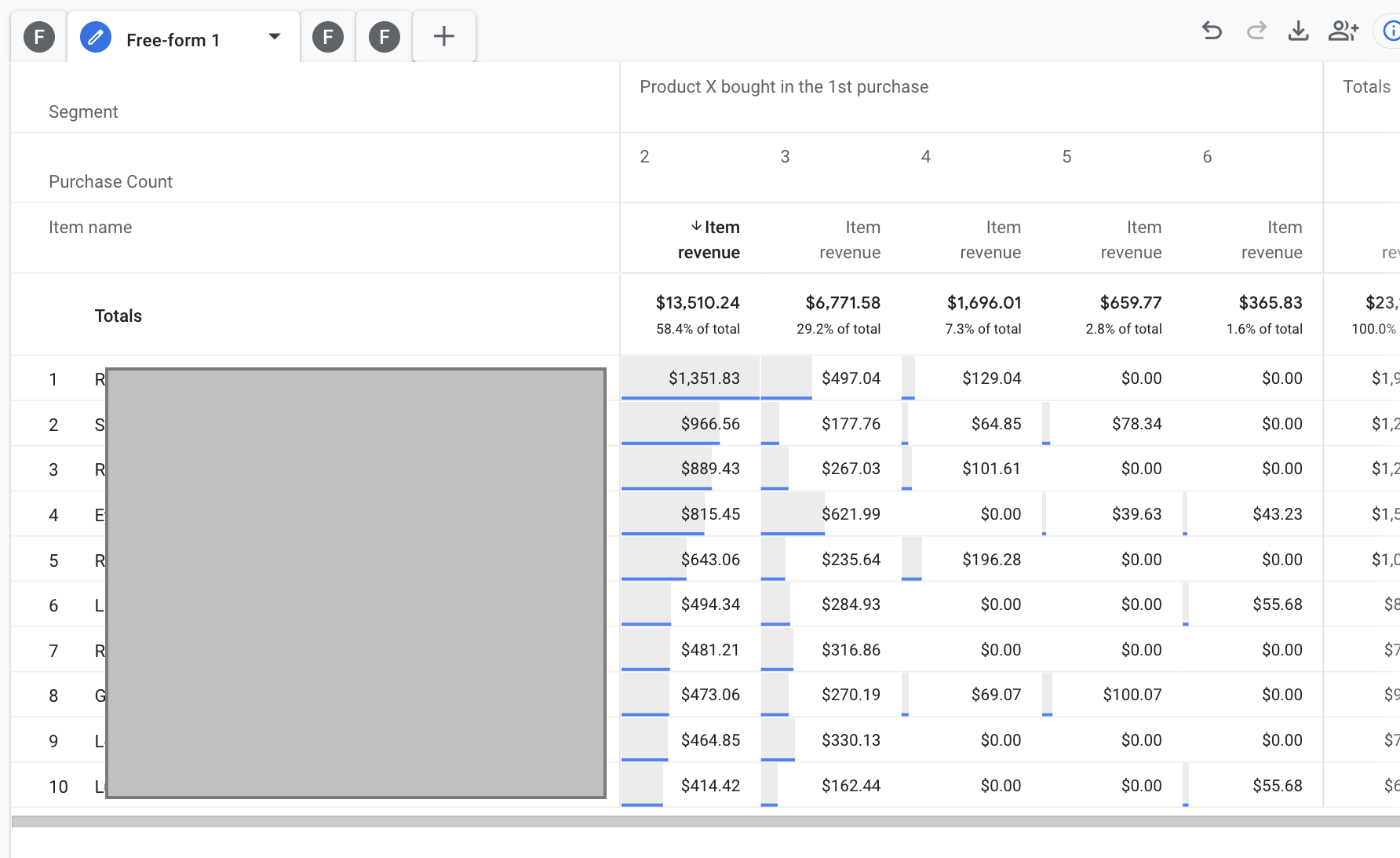
The (grayed out) item name column changed order completely! Mostly because when it comes to sheer volume - Free samples lead the pack of items “sold”.
The point is that these reports are not only about figuring out which products are purchased in the future, you can also measure how much revenue they actually bring in!
Each of these reports creates a "map" of customer behavior. You might find that people who start with Product X rarely buy specifically Product Y in their future purchases, but are more prone to buying other products in subsequent purchases. From here - it’s up to you whether you should push rarely-sold ones OR go with safe bets.
Report 2: the "gateway" head-to-head funnel
We created a two-step purchase funnel to compare users across four different products bought in their first purchase.
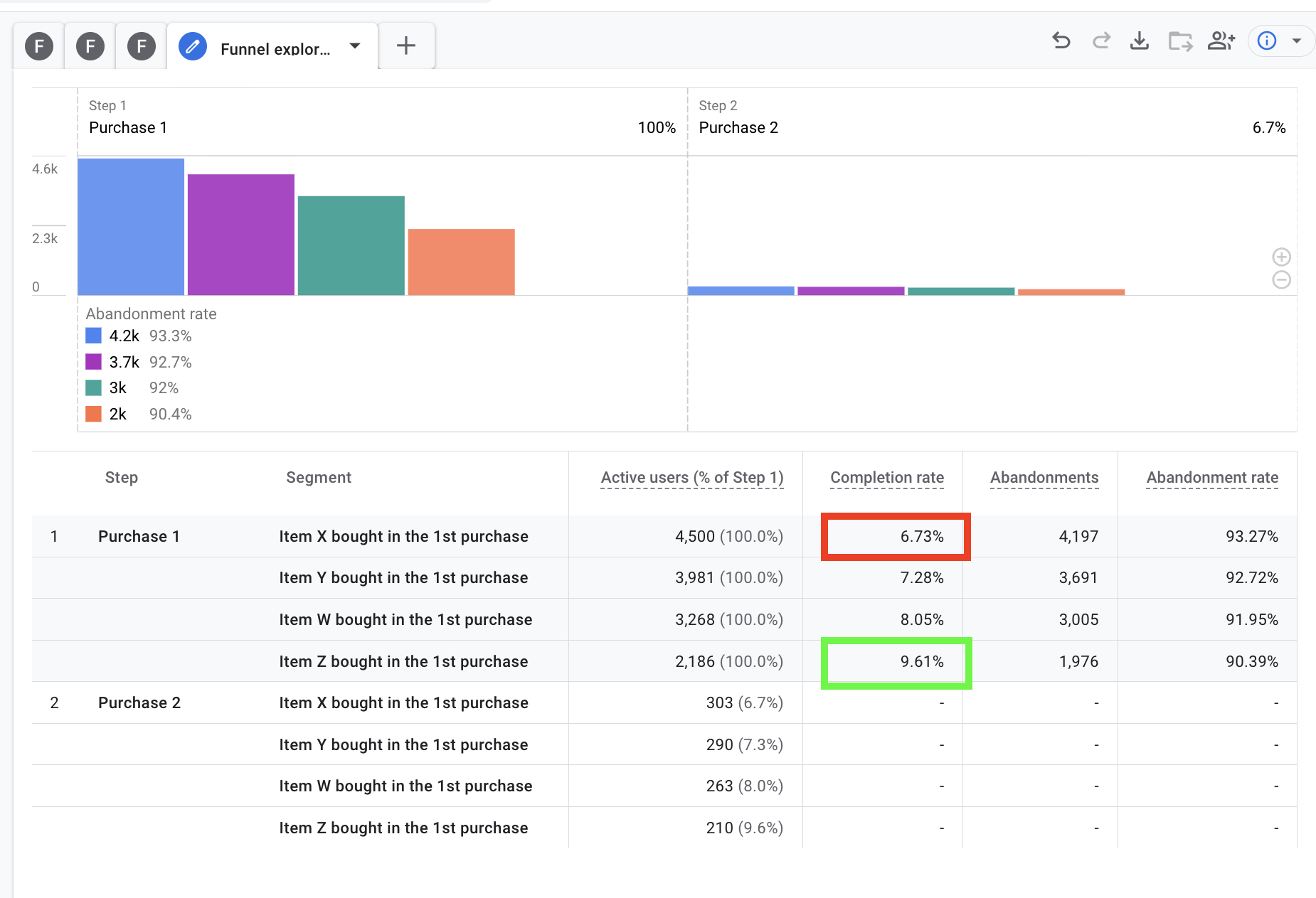
By comparing these four segments, we can see exactly which product has the highest "Repeat Purchase" success. If Product Z has a 9.61% follow-up purchase rate while Product X only has 6.73% but makes it up with a higher volume - it’s up to you to choose where to put your ad spend.
Why this matters for your bottom line
Stop guessing which products to feature in your Top-of-funnel ads. By using the described techniques, you can:
-
Lower your customer acquisition cost (CAC): focus on products that pay for themselves through high LTV.
-
Optimize email flows: if you know someone bought Product A in Order #1, and your data shows most people follow up with Product C, your next email campaign is already written.
-
Scale with confidence: spend your marketing budget on the "Gateway" products that are proven to bring customers back for more.
-
Trust more the data: your most popular product might be your best seller, but your "Gateway" product is your best business builder.
Conclusion
To scale sustainably, Shopify merchants must distinguish between "one-hit-wonder" bestsellers and true gateway products that drive long-term retention and high LTV. By leveraging proprietary GA4 parameter called purchase_count that tracks purchase sequencing, you can stop overspending on stagnant first-time conversions and start investing in the items proven to trigger subsequent orders.
Shopify stores often burn advertising money on 'Bestsellers' that never lead to a second sale. Shifting your ad spend toward the high-affinity products ensures that every new customer isn't just a single transaction, but the start of a high-value relationship.